1. A New Way to Prove that the Gospel of Christ is True
In what year was the Messiah foretold to die for our sins?
Two prophecies tell us when Judah was going to commit its greatest sin by killing the Messiah. The prophecy of Ezekiel 4:4-6 tells us that Judah was going to commit its greatest sin 40 years before the destruction of the second temple, which happened in the Jewish year 3830 AM. The prophecy of Daniel 9:24-27 tells us that Judah was going to cause the destruction of the second temple by killing the Messiah 486 years after the seventh year of Artaxerxes, which was the year 3304 AM. Since 3304 plus 486 equals 3790, and 3830 minus 40 is also equal to 3790, the two prophecies tell us that the Messiah was going to die for our sins in 3790 AM. By the mouth of two witnesses (eg. two prophets) shall every word be established (Deu. ??:??).
In what year was Jesus of Nazareth crucified?
John's Gospel and the three Synoptic Gospels (Matthew, Mark, and Luke) tell us that Jesus of Nazareth was crucified on the Passover in one of five years, 3789 thru 3793 AM, and that it had to have been a year in which the 14th day of Nissan fell on the 5th day of the week. As for which of the five years, if any, had the 14th day of Nissan falling on the 5th day of the week, nobody would know until the 20th century, when modern astronomy enabled the moon phases of ancient Jerusalem to be accurately calculated. According to those calculations, one of the five years (3789 thru 3793 AM) had the 14th day of Nissan falling on the 5th day of the week, and it was the year 3790 AM. Therefore, by the mouth of three witnesses (ie. modern astronomy, John, and the threesome of Matthew, Mark, and Luke), it is established that Jesus of Nazareth was crucified on the Passover in 3790 AM.
Conclusion
Jesus of Nazareth is the Messiah, who died for our sins in 3790 AM according to scripture.
2. John the Telebaptist and the Gift of Discerning Signs
This is about the layman who accidentally discovered how to receive the gift of discerning signs from a spiritual source.
According to Matthew 1:20, the virgin Mary of Nazareth became pregnant with Jesus, not by a man but by the Holy Spirit. If we had a video of every minute of her life, during the month in which she became pregnant with Jesus, then we could prove whether Jesus has a divine Father. But we have no such video.
According to Matthew 3:16, John the Baptist, upon baptizing his cousin Jesus, saw the Sprit of God descend on Jesus just before hearing a voice from heaven saying, "This is my beloved Son, in whom I am well pleased." If we had a video of that, then we could prove that Jesus has a divine Father. But we have no such video.
For almost two thousand years, nobody has been able to prove whether Jesus of Nazareth has a divine Father. That all changed when the Most High gave a sign to a church of which a telebaptist was a member. Before we tell you about the sign, let us tell you what telebaptists have to do with discerning signs.
A telebaptist is someone who was pedobaptized by affusion and credobaptized by immersion without renouncing the pedobaptism. The ancient Greek prefix "tele-" means far off in space or time, and telebaptists are credobaptized far off in time (and usually space) from their pedobaptism.
One day, a pedobaptized layman, whose middle name is John, was credobaptized without renouncing his pedobaptism. He thought he was just getting wet. He had no idea that he was receiving a gift of the Holy Spirit that only a telebaptist can receive. That is the gift of discerning signs from a spiritual source. St. Paul calls it "the discerning of spirits" (1Co. 12:10).
In the early Church, the gifts of the Holy Spirit were received through Baptism (Acts 2:38). But because only the Jews required a sign (1Co. 1:22), only the circumcised received, through their credobaptism, the gift of discerning signs. However, pedobaptism came to replace circumcision; and therefore, the pedobaptized also receive, through their credobaptism, the gift of discerning signs.
So, for the next fifteen years, John the Telebaptist practiced his faith, not knowing that he had a special gift which hardly anybody else had, the gift of discerning signs from a spiritual source. The gift includes the ability to discern the spiritual source of the sign, as well as its meaning and importance.
3. Who Gave the Sign to John's Church?
The sign was given by the only One who could have orchestrated it.
John's Church was named after the Annunciation, which an angel allegedly made to Mary in a vision and to Joseph in a dream (words to remember in bold).
Between the time of the vision and the dream, Mary lived with Elizabeth, who was pregnant with John the Baptist, and Elizabeth's husband Zacharias, who was well-born since he was born into the Jewish priesthood.
If you read all about the Annunciation in the first chapters of Luke and Matthew, and you at least consider the possibility that it might be true, then you will be able to see who gave the sign to John's Church. Everything in the following story is true.
On the outskirts of John's town lived a divorced woman, whose middle name is Marie. She had a live-in boyfriend, whose middle name is Joseph. They were living with a young married couple, whose middle names were Beth, which is short for Elizabeth, and Eugene, which means well-born in Greek.
On a Tuesday or Wednesday night in late September, Marie had an iconoclastic dream of her and Joseph, tearing up a church. She did not tell him about it.
On the morning of Friday the 30th of September, between coffee and cigarettes, Joseph saw an iconoclastic vision of him and Marie tearing up a church. After he told her about it, she told him that she dreamt the same thing a few nights earlier. They were consumed by the coincidence.
They figured that it was a sign from God. But they knew that he wasn't telling them to literally tear up a church, because that would lead to imprisonment and a fine. So, they figured that he was telling them to spread the message of an iconoclast, a message exhorting people to worship God instead of objects.
On Saturday morning, Joseph and Marie woke up, still not knowing which church they were going to bring their message to first. They did not read the weekly 'Religion' section of the local newspaper. If they had, then it would have told them which local church they were going to go to the next day. It was John's church, the one which is named, "The Annunciation of the Lord," and the article was about the relics under their altar.
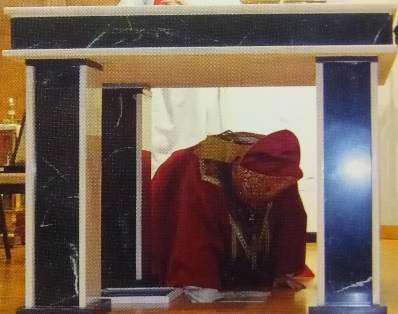
Their bishop puts their relics under their altar.
On Sunday morning, Joseph and Marie woke up, still not knowing which church they were about to visit. So, they drove into town with Beth and Eugene, looking for a church to visit. Upon seeing John's church, the foursome pulled into the parking lot, got out of the car, and wandered into the 11 o'clock Mass. Nothing was going through Joseph's mind as to what they were going to do.
But Marie knew what to do. Right after communion, during a pause, she went up to the altar and began to preach their message to the congregation. Then, Joseph went up to the altar too. But it was not to preach. Instead, he inexplicably decided to lift the 500-pound marble altar and push it down the steps, where it smashed into pieces and tore up the carpet before a stunned congregation.
Their dream and matching vision had been realized, because they had begun to tear up a church by tearing up its centerpiece and some of its carpet. The foursome was taken to jail. Joseph told reporters that he couldn't see what he was doing. Marie said that God must have elevated their abilities, because she does not like to speak in front of crowds, and Joseph cannot lift a 500-pound altar. Beth and Eugene did not speak.
Marie gave her conclusion of the matter when she said, "God allowed us to be his puppets."
Since a layman, whose middle name is John, was the only telebaptist in the church, he was the only one who could discern the sign (see John the Telebaptist and the Gift of Discerning Signs). Nobody else was amazed at the middle names of the vandals. John could see that there are too many antithetic parallels in this true story to dismiss the incident as a coincidence.
John realized that nobody could make all this stuff up, except for a divine Father of Jesus. The overturning of the altar must have been orchestrated by the same One who orchestrated the birth of his son Jesus. The Most High is the One who gave the sign to John's church.
That would be confirmed later when John would discern, through prayer, the meaning and importance of the sign. Besides being meaningful and important, the sign is also a way to prove that Jesus of Nazareth has a divine Father, the Most High, because no one else could have made up the true story, which we have just shared with you.
4. What is the Meaning of the Sign?
The sign means that the souls under the altar in the Fifth Seal, are not the baptized martyrs, who gave up their lives as a holy sacrifice, as the Church has always thought, but they are instead unbaptized martyrs, who are victims of an unholy sacrifice, which is happening today.
The rest of this article is to be written.
5. What is the Importance of the Sign?
The sign is important, because without it, nobody would have ever asked the Most High, in prayer, to teach us what every Christian can do to help stop the unholy sacrifices of the Fifth Seal; and without that prayer, nobody ever would have learned the second part of the eternal gospel, that every Christian is now invited to participate in stopping the unholy sacrifices by signing our petition to help stop forced abortion.
The rest of this article is to be written.
6. What is Chrestianity?
Chrestianity was the original faith of the Church.
Chrestianity is a cross between Hypsistarianism and Trinitarianism. Hypsistarians were monotheistic in the sense that they worshipped only one God, the Most High. But they were also polytheistic in the sense that they acknowledged the possible existence of lesser gods, who would be children of the Most High (not figurative children as in Luke 6:??, but literal children as in Jesus).
NewAdvent, which acknowledges that the Hypsistarians "flourished from about 200 B.C. to about A.D. 400, mostly in Asia Minor (Cappadocia Bithynia, Pontus) and on the South Russian coasts of the Euxine Sea," says, "The existence of these Hypsistarians must have been partially responsible for the astounding swiftness of the spread of Christianity in Asia Minor."
That quote should say "Chrestianity" instead of Christianity, because the members of the first century church in Antioch were called "Chrestians" (see Acts 11:26 in the Codex Sinaiticus).
Since Hypsistarians believed in only one God who is worthy of worship, the Most High, without denying the possible existence of lesser gods, the first Chrestians must have come to realize that one of the lesser gods, namely Jesus Christ, was greater than all the other lesser gods; and therefore, Jesus, despite being lesser than his Father, the Most High, was also worthy of worship.
This means that Chrestianity is a cross between Hypsistarianism and Trinitarianism, which did not become prevalent until the 4th century. Trinitarians elevate the greatness of Jesus to that of his Father, the Most High. Chrestianity is the belief in only two gods who are worthy of worship, the Most High and his son Jesus Christ (ie. a lesser god), without denying the possible existence of other children of the Most High (ie. other lesser gods).
When Chrestians adopted Trinitarianism, a new type of monotheism, they became Christians, and this is reflected in the erasing of most of the H in "XPHCTIAN" to make it say "XPI XTIAN" (see Acts 11:26, 26:28, and 1Pe. 4:16 in the 4th century Codex Sinaiticus).
When the Antichrist is revealed to Christians, they become Chrestians (those who worship two Gods, the Most High and his son Jesus, without denying the possible existence of other lesser gods). That's because these new Chrestians have come to realize that the Antichrist is another son of the Most High and is therefore another lesser god.
New Chrestians see that the Antichrist has deceived every Christian into thinking that he is the Most High and Father of Jesus. They can see how that deception enabled the Antichrist to usurp the headship of the Christ over the Church, so that he could keep "the mystery of lawlessness" (2Th. 2:7) a secret from every Christian.
The mystery of lawlessness is a secret operation of human sacrifice, which the Adversary is currently running (2Th. 2:9, Rev. 6:9-11). Once every Christian has had an opportunity to participate in shutting down the secret operation, the Antichrist will be revealed to participants, and they will become Chrestians. So, whereas Christianity is the faith of the dying Church (dying because members are losing that faith), Chrestianity will be the faith of the resurrected Church (the Church that will follow her Lord in his resurrection).
If you are a Christian and you have not participated in shutting down the secret operation of human sacrifice, then you are invited to participate by signing our petition to help stop forced abortion. Those who believe and participate will be clear from the blood of the victims, but those who do not believe will not be clear.